
The event is over. Now the review begins.
The event may be complete, but understanding what happened is another matter. Evaluators have records to examine, tools to work with, and findings to establish before the next decision can be made.
This is where the review begins, and where Field IQ fits.
The exercise is over. Now what?
The exercise has concluded. Participants have finished their work, the recorded activity is available, and attention turns to evaluating what happened. Before anyone can draw useful conclusions, the team needs to understand what the event actually produced and what can be examined.
COMPLETED EVENT / RECORDED ACTIVITYThe event left records, not conclusions.
Movement data, timestamps, logs, and observations capture different parts of the event. Some records describe where something happened, others when it happened, and others what someone observed. Together, they provide material for review, but they do not arrive as one complete, agreed-upon interpretation.
EVIDENCE / NOT YET INTERPRETATIONExisting tools help reconstruct the event.
Evaluators may use replay systems, simulation environments, visualizations, reports, and AI-assisted analysis to revisit what unfolded. These tools help reveal sequences, relationships, and details that may be difficult to see from individual records. They remain valuable parts of the review process.
But reconstructing an event is not the same as establishing what the evidence supports.
REPLAY · VISUALIZATION · REPORTS · AIBut what does the evidence actually support?
Reconstructing what happened is one part of the review. Establishing the evidence behind a finding is another. When an evaluator identifies a pattern, questions an action, or reaches a conclusion, they need to examine what supports it and distinguish what was recorded from what was interpreted. That connection matters when findings are challenged, revised, or revisited later.
SOURCE TRACEABILITY / HUMAN REVIEWStart with the evidence.
Field IQ Event Review produces an evidence-linked first pass from supported completed-event records. It organizes review outputs and preserves connections to their original sources, giving evaluators a structured, inspectable starting point. Evaluators can examine the underlying evidence, develop interpretations, record disagreement, and revise their findings without confusing human judgment with the original record.
See the real Event Review example →EVIDENCE-LINKED FIRST PASSThe judgment stays human.
Evidence can inform a review, but it does not make the final judgment. The evaluator determines what the available record means, identifies questions that remain, and decides what needs further attention. The resulting review may support an after-action discussion, additional investigation, revised training, or another human-owned decision.
INTERPRETATION · REVISION · HANDOFFSee the evidence behind the review.
We've followed the review from a completed event to the evaluator's next decision. Now let's look at what sits between them: the evidence, the analytical output, and the interpretation that follows.
Field IQ Event Review produces an evidence-linked first pass from supported event records, preserving the connection between review outputs and their original sources. That gives the evaluator something concrete to inspect, question, and build upon.
From source evidence to an inspectable review.
A recorded event provides the source material. Field IQ organizes supported records into a first-pass review, with analytical outputs linked back to their underlying evidence.
The evaluator can then examine that basis, add interpretation, challenge a finding, and determine what should happen next.
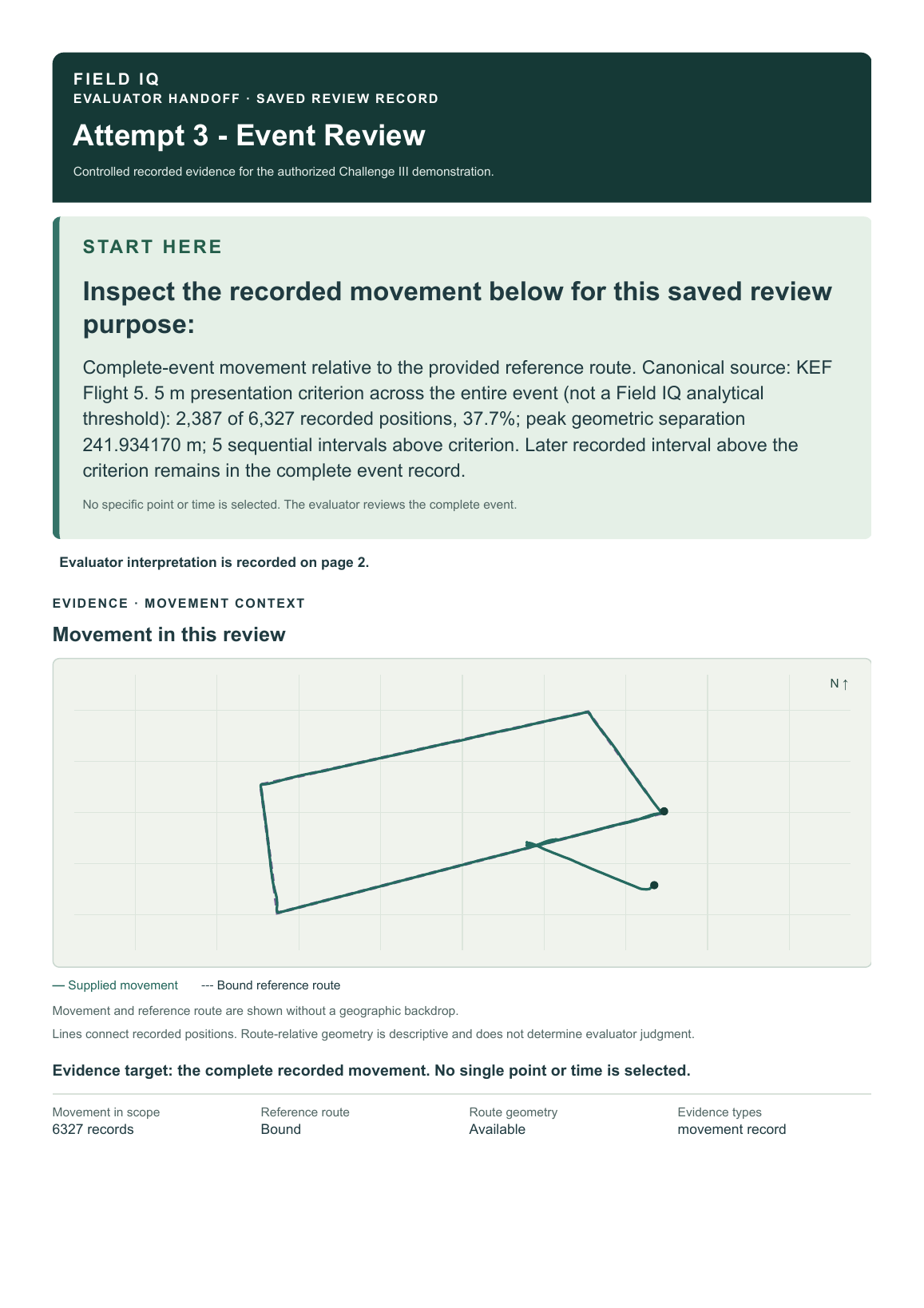
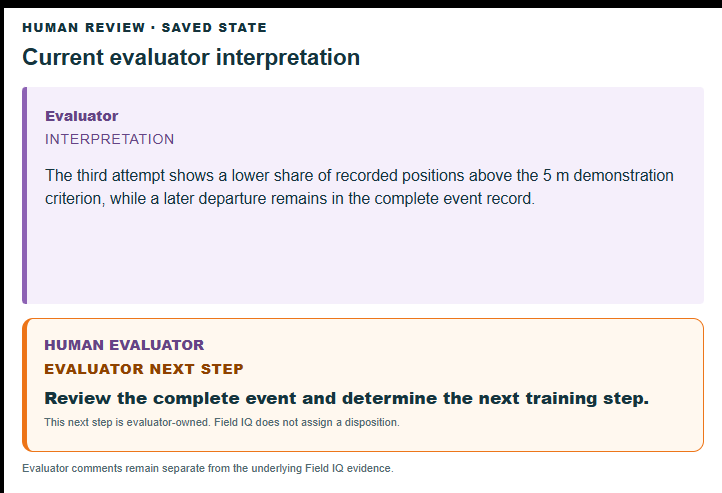
- Original evidence
- The recorded information available for examination. Here, the complete KEF Flight 5 movement record: 6,327 positions.
- Evidence-linked first pass
- The structured review output and its connection to source material. The review page identifies KEF Flight 5 as its canonical source.
- Evaluator interpretation
- The human assessment, kept distinct from what was recorded.
- Next step
- The decision or follow-up action owned by the evaluator.
The reference geometry and 5 m criterion in this example were constructed for demonstration, rather than representing historical mission-performance grading. The saved interpretation is human-authored.
See how the evidence-linked first pass, source inspection, and evaluator-controlled review come together in the Event Review application.
Explore Field IQ Event ReviewContextual military photography does not imply Field IQ use or integration.
Photography: Training exercise · DVIDS · RVTT operations center · Sgt. Ryan Scribner, U.S. Army National Guard · 40th Infantry Division after-action review · Staff Sgt. Scott Evans, U.S. Army
The next decision should never lose its connection to the evidence behind it.