Field IQ helps training, test, and experimentation teams turn completed-event movement data into a structured, evidence-linked starting point for review.
Post-mission. Read-only. Deterministic. Traceable. Built to support evaluator judgment.

The data may already exist. The usable review usually does not. After a training event, test, or experiment, teams may already have movement records, observations, playback, and other source material.
The harder part is lining up the records, rebuilding the sequence, checking the evidence, and turning it into something the review can use. Field IQ helps the team begin with a structured, evidence-linked first pass so more of the review can focus on what matters.
Field IQ does not decide what an event means. It organizes supported post-event evidence into a repeatable, inspectable first pass so evaluators and analysts can begin from something concrete.

Field IQ works with existing replay, GIS, reporting, and evaluator workflows. It turns supported completed-event exports into an evidence-linked starting point the review team can inspect and use.
Works from supported completed-event movement/location records without live intervention, operational control, or alteration of the source event. Built for review after the event.
Supported inputs, code, configuration, and runtime produce repeatable results.
Repeatable enough to inspect and challenge.
Surfaced results retain a path back to supporting records and source identity.
The evaluator decides what the evidence means.
Field IQ is currently best suited to completed events with structured, timestamped movement/location data and a real human review step afterward. That can include movement-data-rich training, AAR, test and evaluation, experimentation, and supported unmanned-system or route-based review workflows.
Start with one completed event and a supported structured, timestamped movement/location export. Add a valid supplied historical plan or approved reference route only when plan comparison is needed.
Field IQ produces a recorded movement path, relative event sequence, concrete source and validation facts, visible limitations, and, when valid route evidence exists, neutral plan-relative geometry. Human reviewers decide what it means.

Field IQ organizes supported, timestamped movement/location records from a completed event into a stable actual-path representation and relative event sequence.

Field IQ preserves concrete information about the source, timing, record support, and validation state behind its outputs.
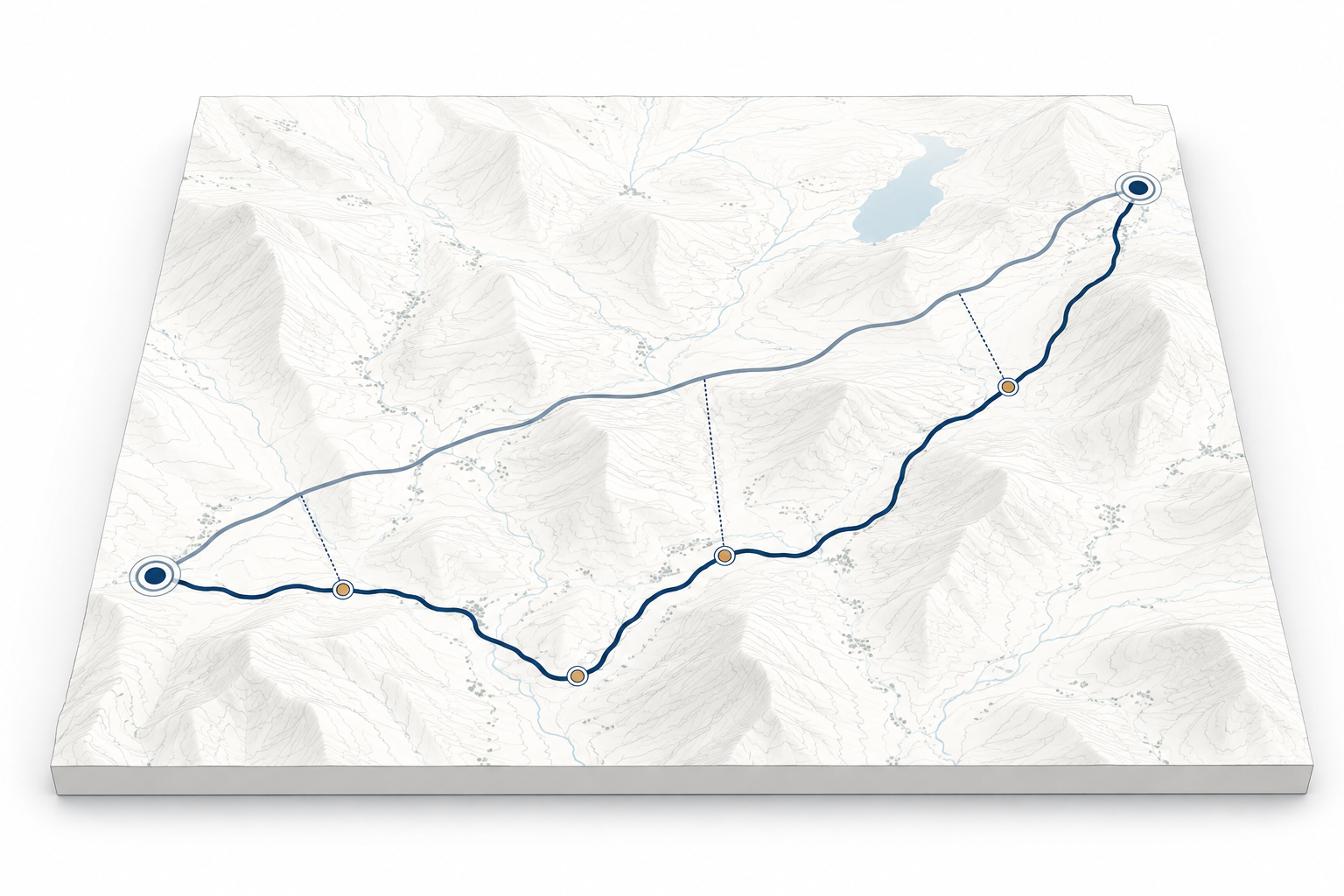
When a valid supplied historical plan or approved reference route is available, Field IQ can calculate descriptive geometric separation between the recorded path and that continuous route.
Illustrative evidence state
Missing plan evidence does not mean zero or on plan. The plan-relative result is not produced.
If required plan evidence is absent, plan-relative analysis does not silently become zero, on plan, or no issue.
Reviewers can inspect how a result was produced and where its supporting evidence came from.
Surfaced result to normalized observation to source record to source file identity.
The same supported inputs, code, configuration, and runtime produce the same governed result.
Determinism makes results inspectable, reproducible, and contestable.
Concrete integrity, completeness, provenance, and result-support facts remain available for review.
Reviewers can inspect the evidence behind a result without relying on a generalized confidence label.
Field IQ has produced repeatable, traceable outputs from third-party unmanned aircraft movement data under a controlled review workflow.
Bring one completed event, one supported movement-data export, and one real review workflow. We’ll determine whether the available data and review question fit. The practical question is simple: does this give the team a better starting point for review?
Tell us about the completed event, the available movement data, and the review question. We’ll help determine whether Field IQ fits.
Typical conversations cover AAR and review workflows, data availability, handling requirements, and evaluation scope.
Do not send raw event data through this form. We establish secure transfer and handling requirements separately when needed.
Legal Entity: Field IQ Systems LLC
UEI: TNUQSL6AP3K1
CAGE: 19P73
Clear answers on capabilities, deployment, and evaluation fit.